
Request routing and draft responses
Classify incoming requests, prepare a response for review, and route the work to the right person. Define exceptions and approvals before any message or system update is automated.
Reduce repeated work in the systems your team already uses. Correll Technologies helps organizations define an automation pilot, connect their tools, and evaluate whether the result is useful enough to operate.
Explore the workA useful automation begins with a specific bottleneck: requests waiting to be routed, documents that take too long to find, or information copied between systems. We compare rules, integrations, and AI against that task before choosing an approach.
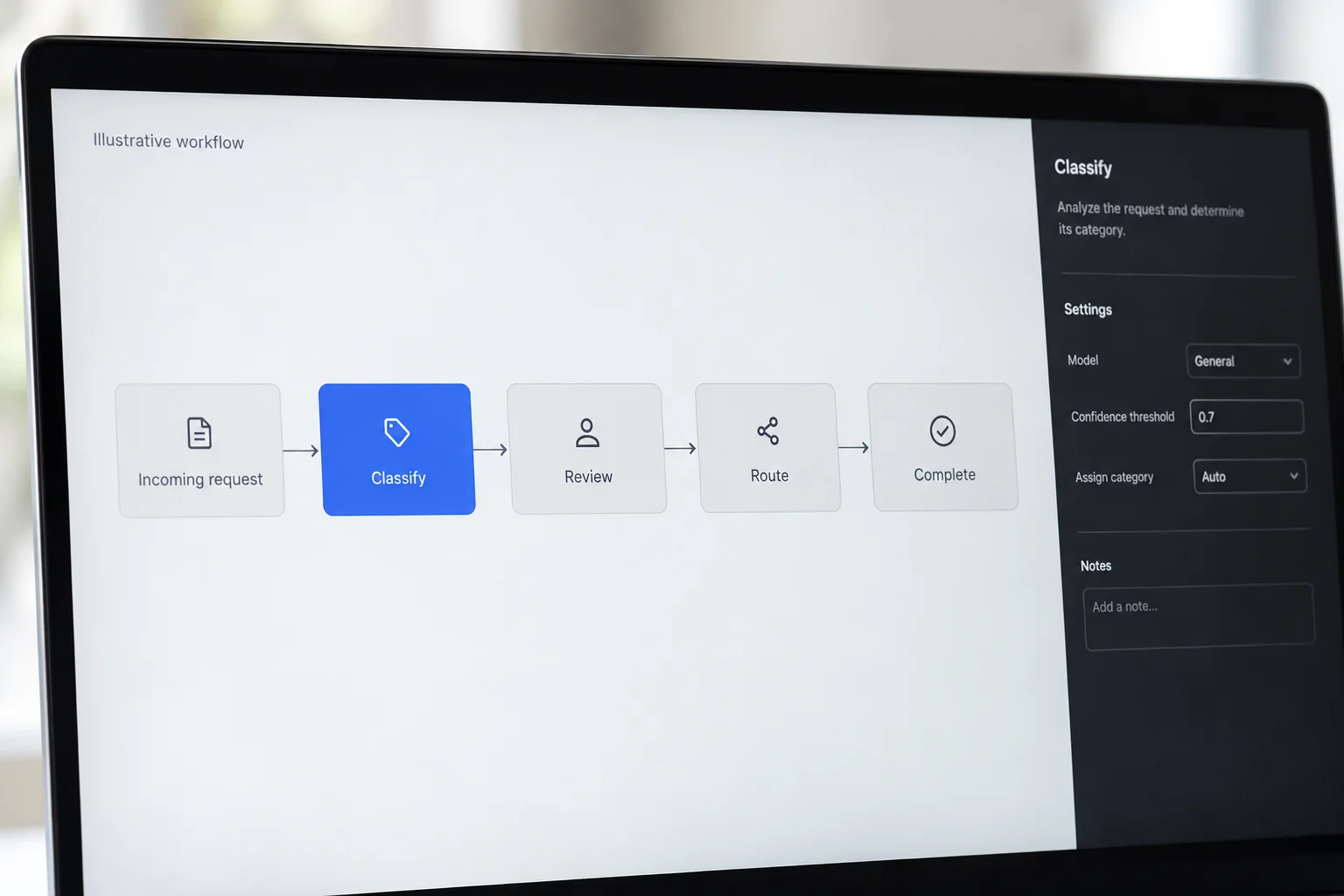
Classify incoming requests, prepare a response for review, and route the work to the right person. Define exceptions and approvals before any message or system update is automated.
Help staff find relevant information across an agreed set of business documents. Evaluate source citations, access permissions, outdated content, and questions the system should decline to answer.
Connect steps across existing tools when their APIs and permissions allow it. Plan validation, duplicate handling, failed updates, and the person responsible for recovery.
Test representative tasks, record review time and correction rates, and compare ongoing costs with the existing process. Agree on monitoring, access, and support before rollout.
A pilot should make the tradeoffs visible before you commit to a broader rollout. We define the workflow, success criteria, and limits together.
Identify the people, inputs, systems, and exceptions involved. Measure the current time and error rate where data is available.
Select one workflow and an approved data sample. Compare ordinary automation with AI, then agree on acceptance scenarios and required human review.
Run representative cases, incorrect inputs, permission boundaries, and recovery scenarios. Review results with the people who will use the workflow.
Compare results with the baseline, include review and maintenance costs, and document the decision to expand, revise, or stop the pilot.
Our US-based team supports businesses across the United States. Discovery and implementation can be delivered remotely; collaboration hours, meeting arrangements, and data-access requirements are agreed for each project.
Not always. A fixed routing rule or straightforward data transfer often needs an integration rather than AI. We use AI when interpreting variable language or documents is part of the task and its output can be evaluated.
We first assess APIs, permissions, vendor restrictions, and data quality. Those constraints determine what is feasible and what still needs a manual step.
That depends on the selected provider, account configuration, and contract. We review data handling and access requirements during discovery rather than assume every AI service has the same policies.
Scope, integrations, data preparation, evaluation, and support determine the cost. The proposal should separate implementation from recurring model, hosting, and maintenance costs.
We can scope the application and automation together. Our custom software service covers business applications, portals, and the interfaces people need to review and manage automated work.